
Is Monocouche Render Better Than Traditional Render?
If you are planning to render your home, one of the biggest questions you’ll face is:
“Is monocouche render better than traditional render?”—and is it truly worth the investment?
The short answer is yes—in many situations, monocouche render is the better option when compared to traditional sand-and-cement mixes. It offers rapid application, built-in colour that never needs painting, and highly reliable cracking resistance.
However, that doesn’t mean traditional render is completely outdated or unsuitable. Both systems have their place, and choosing the right one depends on your property’s construction, your budget, and the finish you’re trying to achieve.
Having installed rendering systems on modern homes, extensions, refurbishment projects, and older properties across the UK, we’ve found that there is no universal solution. The best render is the one that’s appropriate for the building—not simply the newest or cheapest option.
In this guide, we’ll compare monocouche render vs traditional render based on practical installation experience rather than manufacturer marketing.
If you are planning to render your home, one of the biggest questions you’ll face is:
“Is monocouche render better than traditional render?”—and is it truly worth the investment?
The short answer is yes—in many situations, monocouche render is the better option when compared to traditional sand-and-cement mixes. It offers rapid application, built-in colour that never needs painting, and highly reliable cracking resistance.
However, that doesn’t mean traditional render is completely outdated or unsuitable. Both systems have their place, and choosing the right one depends on your property’s construction, your budget, and the finish you’re trying to achieve.
Having installed rendering systems on modern homes, extensions, refurbishment projects, and older properties across the UK, we’ve found that there is no universal solution. The best render is the one that’s appropriate for the building—not simply the newest or cheapest option.
In this guide, we’ll compare monocouche render vs traditional render based on practical installation experience rather than manufacturer marketing.
Quick Property Advisory
Unsure which render system fits your property substrate or local UK weather conditions?
Get an instant recommendation tailored to your project.
What Is Monocouche Render?
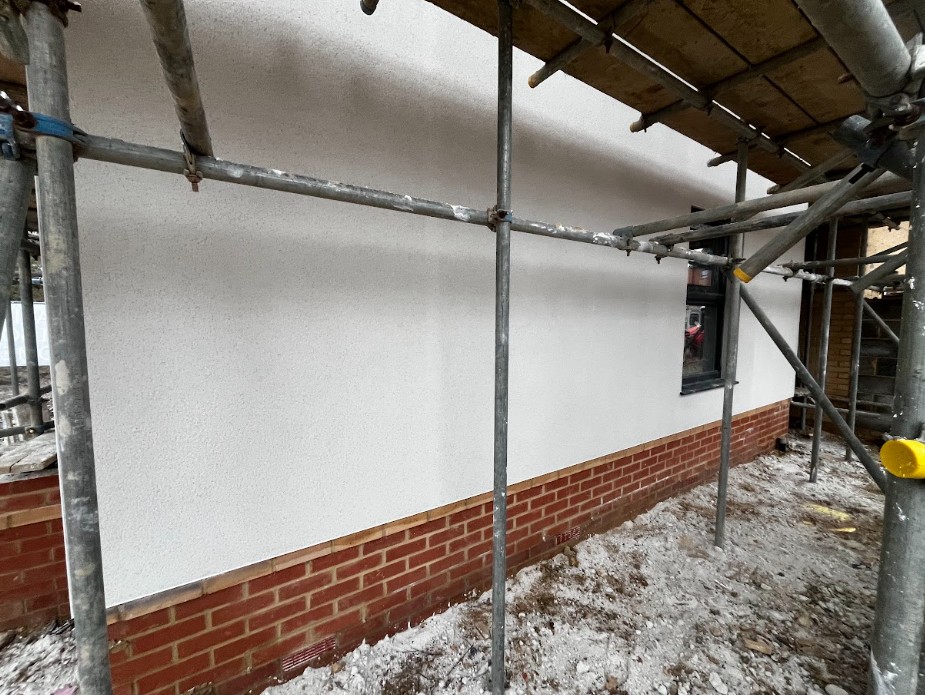
Monocouche render is a through-coloured cement-based render that provides both the protective weather layer and the finished decorative appearance in one single system.
Unlike traditional render, the colour is built directly into the material itself, meaning it doesn’t require painting once installation is complete.
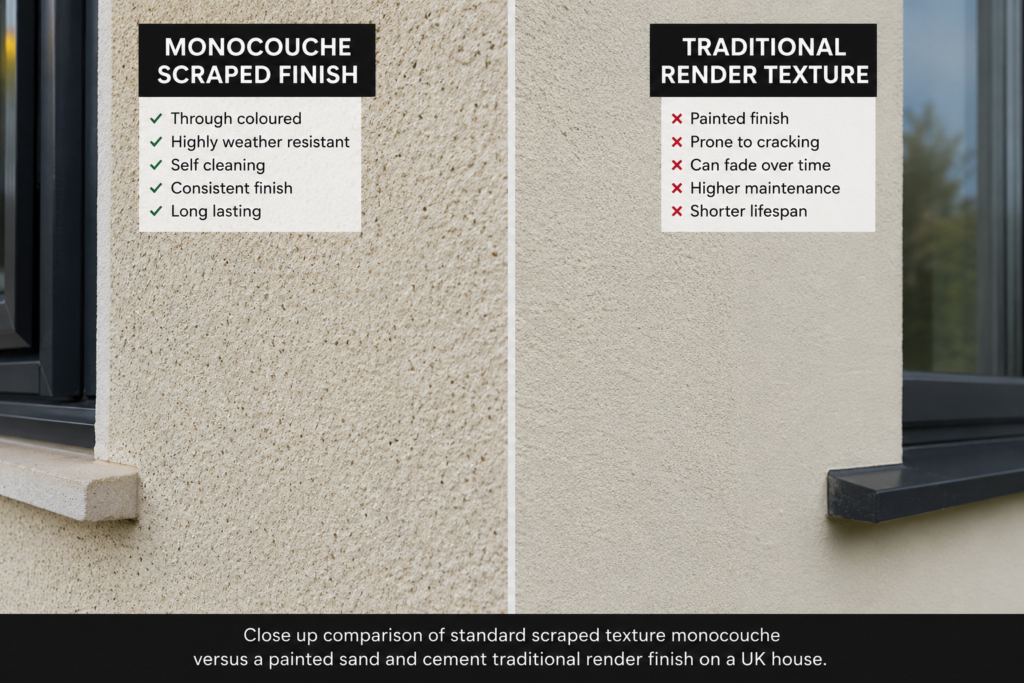
Monocouche Rendering Pros and Cons
When developers consider the advantages of this system, they note several distinct benefits:
- Pros:
- Low Maintenance: No initial or repetitive painting cycles required.
- Faster Application: Applied as a single coat in two passes, cutting down on-site labor times.
- Consistent Aesthetics: Delivers a modern, flat, light-reflective stone-aggregate texture.
- Cons:
- Higher Initial Cost: Material costs are higher than standard local sand-and-cement bags.
- Visible Patching: Structural repairs later down the line are harder to blend than painted surfaces.
Is Monocouche Breathable?
Yes! One of its biggest technical advantages is breathability. Its lime-inclusive factory formulation permits trapped indoor water vapour to vent naturally into the atmosphere, preventing damp accumulation inside the masonry walls.
What Is Traditional Render?
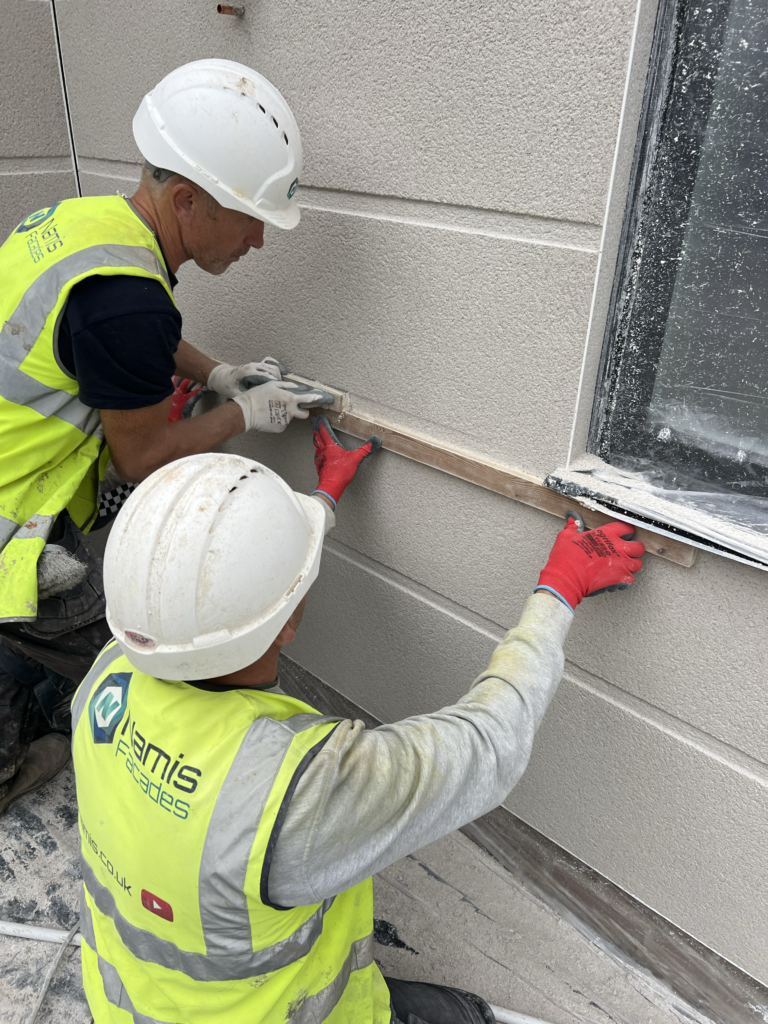
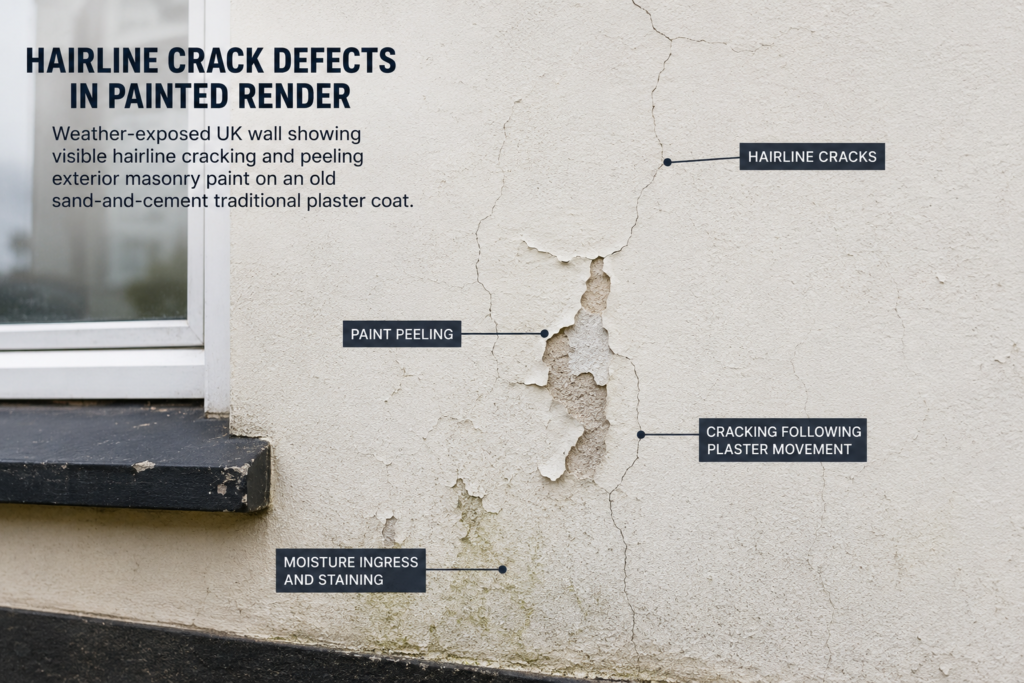
Traditional render is typically made from a sand, cement, and lime mix and is applied on-site in multiple coats (scratch coat and floating coat) before being hand-finished and painted.
Although it is one of the oldest rendering methods still in use, it remains a logical solution for certain UK properties—particularly where structural breathability or localized repairs are needed.
Core Applications:
- Older masonry properties and heritage buildings.
- Small, localized patch repair works.
- Decorative or multi-color painted finishes.
- Projects where a highly flexible lime-only render is required on soft brickwork.
Technical Comparison Matrix
To help you visualize how these systems compare side-by-side, here is a breakdown of their primary technical parameters:
Feature Segment | Monocouche Render | Traditional Sand & Cement |
Base Material | Factory pre-bagged limestone & hydrated white cement with polymer fibers. | Sharp sand, builders lime, and standard grey Portland cement mixed on-site. |
Decoration Requirement | None. Fully pre-coloured through the material. | Mandatory. Requires 2-3 coats of masonry paint and repainting every 3–5 years. |
Flexibility & Cracking | High. Resists micro-settlements and contains fiber reinforcing elements. | Extremely Low. Highly rigid; prone to shrinkage, frost fractures, and cracks. |
Breathability Profile | Outstanding. Highly vapor permeable, prevents structural damp traps. | Low. Heavy sand block absorbs moisture; painting can block water vapor exit. |
Average Upfront Cost | £40 – £55 per m² of wall area | £30 – £40 per m² (but adds £15-£25/m² for paint and extra labor) |
Lifespan Expectation | 25+ Years with minimal care | 10 – 15 Years (due to paint peeling and damp ingress) |
Estimate Your Rendering Project
Planning an extension or full facade renovation?
Try Our Interactive UK House Rendering Cost Calculator to receive an instant, accurate estimate based on your exact wall square footage and region.
Detailed Cost Analysis: The True Lifetime Investment
When looking at quotes for a house rendering cost UK, many homeowners make the mistake of looking only at the upfront labor rates. Traditional sand and cement render often looks cheaper initially because raw sand and cement bags are inexpensive.
However, when you analyze the total project cost, traditional render requires:
- Extra scaffolding hire days while waiting for coats to dry.
- The purchase of premium exterior masonry paints.
- Professional decorators to apply 2 to 3 coats of paint.
- Ongoing repainting every 3 to 5 years to maintain its appearance and water resistance.
Over a 10-year lifecycle, monocouche render is almost always the more economical choice. It eliminates the cost of subsequent repainting and prevents moisture-induced cracks that require expensive remedial work.
Key Considerations: Choosing the Right Render for Your Substrate
Substrate Compatibility
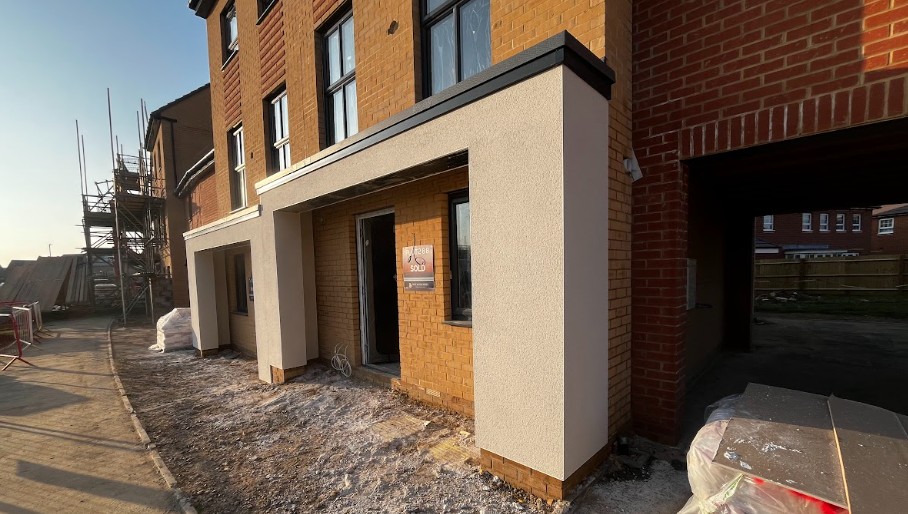
- Modern Blockwork: Monocouche is ideal. It adheres perfectly to dense aggregate blocks and handles minor settling.
- Old Brickwork/Stone: Traditional lime-modified sand and cement mixes may be safer to prevent trapping moisture in old, soft brick.
K Rend vs Traditional Plaster
Brands like K Rend produce premium pre-bagged monocouche systems that include silicone water repellents inside the mix. Compared to traditional plaster mixes, K Rend offers significantly greater resistance to algae growth and weather-staining, making it highly suitable for coastal or high-exposure areas of the UK.
Frequently Asked Questions (FAQ)
1. Does monocouche render crack?
While monocouche contains polymer fibers that make it far more flexible than traditional sand and cement, no cementitious product is completely crack-proof. Hairline cracks can occur if there is significant structural movement in the property or if mesh reinforcement wasn’t used over joint stresses.
2. Can you paint over monocouche render if you want to change the colour?
Yes. If you decide to change the color in the future, monocouche render can be painted using high-quality, breathable silicone masonry paints. However, once painted, you will have to repaint it periodically, losing its “zero-maintenance” benefit.
3. How do you clean monocouche render?
Monocouche render has a slightly textured surface that can gather dust and biological growth over several years. It can be cleaned easily using specialized, gentle biocidal washes or low-pressure steam cleaning. Avoid high-pressure jet washing, as it can damage the surface texture.
Get an Expert Site Assessment
Let our technical team evaluate your property’s substrate and provide a detailed, itemized quote.
Schedule a Specialist Property Survey and Free Quote with Namis Facades today!